Company Registration and Corporate Compliance

Company Registration and Corporate Compliance in Nepal: A Comprehensive Guide
Starting and operating a business in Nepal requires a deep understanding of local laws, proper company registration, and continuous regulatory compliance. These processes ensure that your business functions lawfully, transparently, and sustainably under Nepalese law.
Top Legal Advisers provides end-to-end legal support for company incorporation and ongoing corporate compliance in Nepal. We assist domestic and foreign entrepreneurs, startups, investors, and established enterprises at every stage of their business lifecycle.
1. Company Registration in Nepal
Company registration is the formal process of incorporating a business under theCompanies Act, 2063 (2006). Upon registration with the Office of the Company Registrar (OCR), a company acquires a separate legal identity. This legal status enables an entity to:
- Enter intocontracts in its own name.
- Own and transfer property.
- Sue and be sued.
- Operate as a legally recognized business entity.
Types of Companies in Nepal:
Choosing the right structure is critical for your business goals. Below is a breakdown of the common entity types:
|
Type of Company |
Key Features |
Suitable For |
|
Private Limited Company |
Limited liability, minimum one shareholder, no public share issuance |
Startups, SMEs, family businesses |
|
Public Limited Company |
Can raise capital from the public, higher compliance obligations |
Large businesses, investor-driven companies |
|
Profit Not Distributing Company |
Established for social or charitable objectives |
NGOs, social enterprises |
|
Foreign Company |
Branch or liaison office of a foreign entity |
International companies operating in Nepal |
Step-by-Step Company Registration Process:
The registration process involves several technical and legal steps:
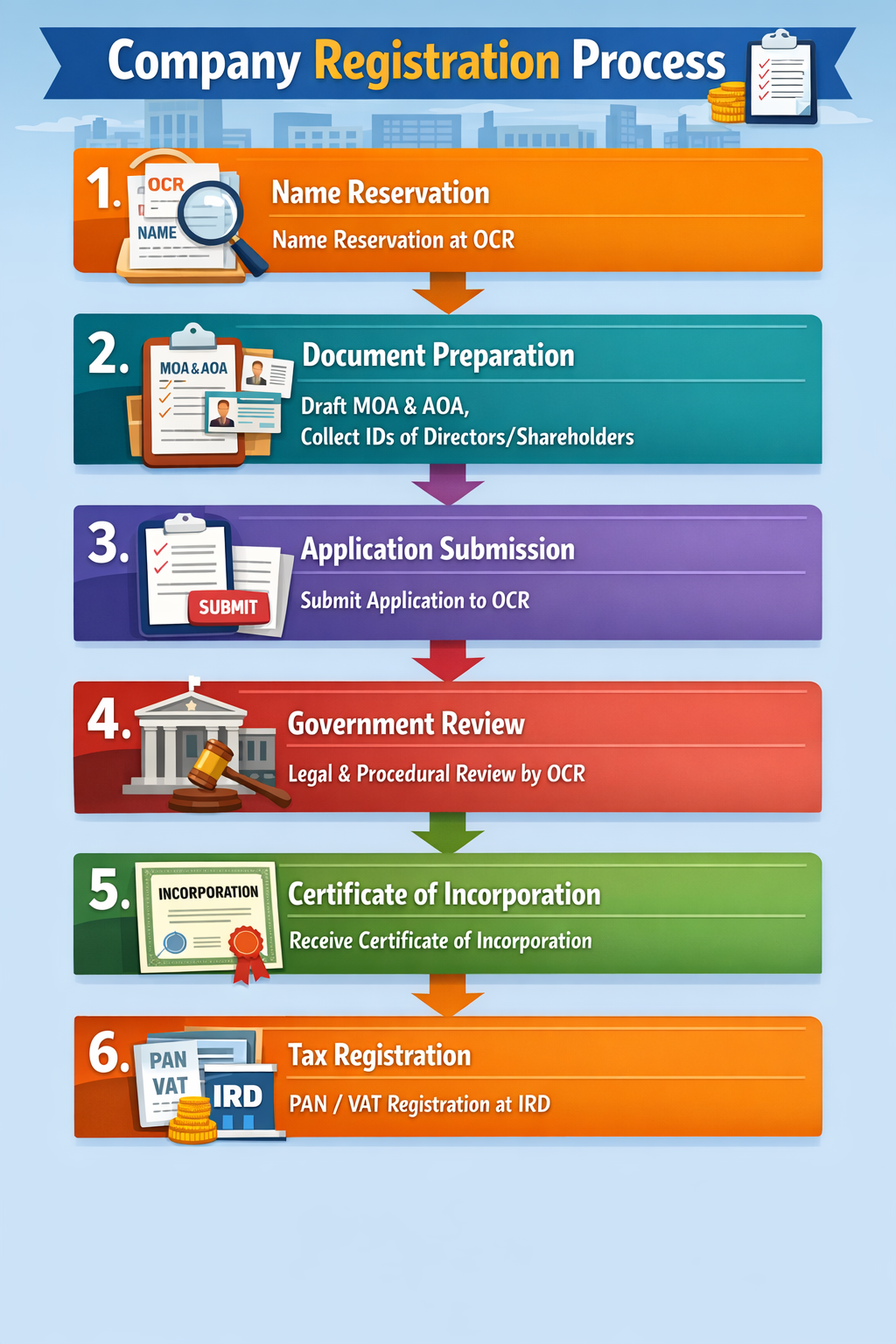
|
Step |
Description |
|
1. Name Reservation |
Reservation of a unique company name at the OCR |
|
2. Document Preparation |
Drafting of MOA & AOA; collection of IDs of directors/shareholders |
|
3. Application Submission |
Filing the incorporation application with the OCR |
|
4. Government Review |
Legal and procedural review by the OCR |
|
5. Certificate of Incorporation |
Issuance upon formal approval |
|
6. Tax Registration |
PAN/VAT registration at the Inland Revenue Department (IRD) |
Our Registration Services Include:
- Name availability checks andreservation.
- Drafting Memorandum and Articles of Association (MOA & AOA).
- Complete OCR filings and professional follow-ups.
- PAN and VAT registration coordination.
- Expert advisory on company structure and shareholding.
2. Corporate Compliance in Nepal
Company compliance refers to the ongoing legal, financial, and regulatory obligations required to maintain lawful business operations. Proper compliance enhances corporate governance, investor confidence, and operational stability.
Key Annual Compliance Requirements:
|
Requirement |
Responsible Authority |
|
Annual Return Filing |
Office of the Company Registrar (OCR) |
|
Annual General Meeting (AGM) |
Mandated by the Companies Act |
|
Audited Financial Statements |
External Auditor / OCR |
|
Income Tax Filing |
Inland Revenue Department (IRD) |
Tax Compliance and Reporting Frequency
Businesses must adhere to strict filing timelines to avoid penalties.
|
Compliance Area |
Filing Frequency / Timeline |
|
Income Tax |
Annually |
|
VAT |
Monthly / Quarterly |
|
Withholding Tax |
As applicable |
|
Annual Return |
After the AGM |
|
Public Company Reports |
Quarterly / periodic |
Major Regulatory Authorities:
|
Authority |
Role in Nepal |
|
OCR |
Company incorporation and corporate filings |
|
IRD |
Tax administration and enforcement |
|
SEBON |
Regulation of public companies |
|
Department of Industry (DoI) |
Industrial approvals and licenses |
|
Sectoral Regulators |
Industry-specific oversight (e.g., NRB for banks) |
3. Why Compliance Matters
Maintaining a "compliant" status is more than just a legal requirement; it is a strategic business advantage:
- Legal Security: Avoid fines, penalties, and costly legal disputes.
- Business Credibility: Build trust with investors, banks, and international partners.
- Operational Stability: Prevent disruptions caused by regulatory violations.
- Investment Readiness: Facilitatefunding, mergers, and partnerships.
- Ethical Environment: Promote transparency and accountability.
Consequences of Non-Compliance:
|
Violation |
Potential Consequences |
|
Late Filings |
Monetary fines and late fees |
|
Tax Evasion |
Heavy penalties and interest |
|
Repeated Non-Compliance |
Blacklisting or suspension of the entity |
|
Serious Violations |
Personal liability of directors |
4. Industry-Specific Compliance
Different sectors in Nepal are governed by additional regulatory frameworks:
|
Sector |
Regulator / Requirement |
|
Banking & Finance |
Nepal Rastra Bank (NRB) |
|
Healthcare |
Specific licensing and quality standards |
|
Manufacturing |
Environmental compliance standards |
|
Telecommunications |
Sectoral approvals from relevant authorities |
5. Professional Legal Support & Outsourcing
Top Legal Advisers assists clients in risk mitigation, penalty avoidance, and regulatory rectification. By outsourcing compliance functions, you ensure accuracy and allow your business to focus on growth.
Our Comprehensive Support Includes:
- Tax filing and accounting coordination.
- Annual return and statutory filings.
- Legal documentation and record maintenance.
- Regulatory monitoring and deadline management.
- Strategic compliance planning and advisory updates.
Ready to Register Your Company or Manage Compliance in Nepal? Contact us today for professional legal support and regulatory peace of mind.
Frequently Asked Questions (FAQ)
1. What law governs company registration in Nepal?
Companies are incorporated under the Companies Act, 2063 (2006).
2. Which office handles company registration?
The Office of the Company Registrar (OCR) is responsible forcompany incorporation and corporate filings.
3. What documents are needed to register a company?
Key documents include the Company Incorporation Application, Memorandum & Articles of Association (MOA/AOA), and citizenship or passports of directors and shareholders.
4. How often must I file an Income Tax return?
Income tax must be filed annually with the Inland Revenue Department (IRD).
5. What happens if I miss a filing deadline?
Late filings typically result in monetary fines and late fees. Serious or repeated violations can lead to the personal liability of directors or the blacklisting of the company.
6. Can a foreign company operate in Nepal?
Yes, foreign companies canoperateas a branch or liaison office of a foreign entity.